 Badania Media
Positive Media Education 4.0
The Media Research Centre conducts interdisciplinary research on Positive Media Education 4.0 (PME 4.0), a new analytical model integrating media studies, media psychology, and positive psychology in order to examine the impact of media and digital competencies on the digital well-being of young adults. The starting point of the project is the assumption that the contemporary media environment constitutes a complex ecosystem of individual functioning, in which media no longer serve solely an instrumental role but have become a space for the fulfilment of cognitive, social, and emotional needs.
In contrast to dominant approaches focused on risks and threats, PME 4.0 advances a positive perspective by shifting the emphasis from a deficit-oriented model to a developmental one, in which media and digital competencies are understood as resources that condition individual well-being. This model integrates Martin Seligman’s PERMA framework of well-being, encompassing positive emotions, engagement, relationships, meaning, and achievement within the digital environment.
The research conducted at the Centre assumes that the level of media and digital competencies influences not only the quality of individual functioning in online environments but also digital well-being and digital resilience, understood as the capacity to cope with technostress, information overload, and the challenges of digital communication. Particular attention is devoted to psychological mechanisms such as self-regulation, self-reflection, and intentionality, which mediate the relationship between competencies and well-being.
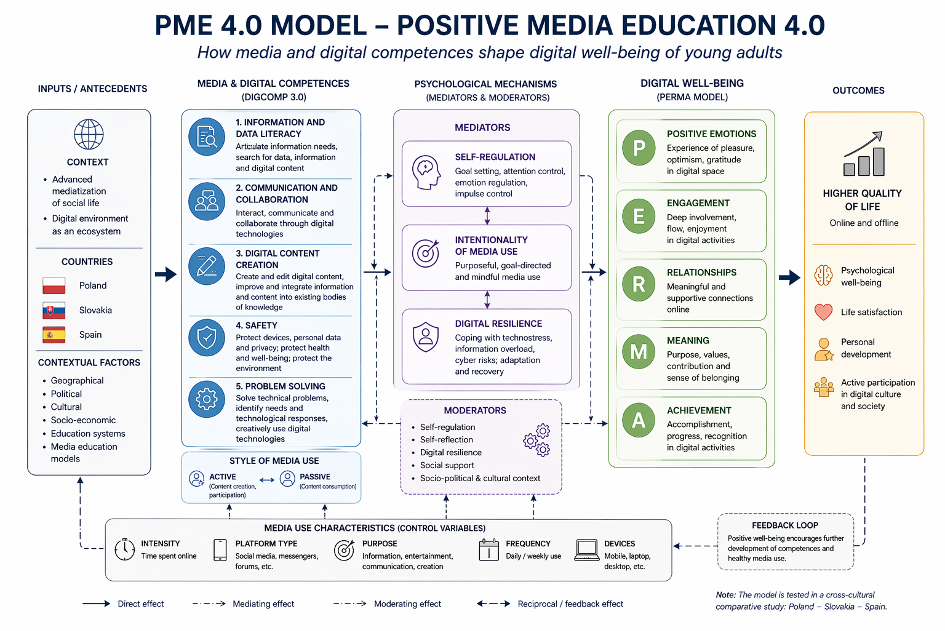
An important component of the project is also a cross-cultural perspective, including comparative studies conducted in Poland, Slovakia, and Spain, enabling the analysis of the influence of socio-cultural and educational contexts on the relationship between media competencies and digital well-being. The project also draws on the European Digital Competence Framework (DIGCOMP 3.0), treating it as a reference point for the operationalisation of research variables.
The aim of the research is the empirical development and validation of the PME 4.0 model, as well as the identification of mechanisms through which media and digital competencies translate into the digital well-being of young adults. In particular, the study examines the relationships between specific dimensions of competencies (information literacy, communication, content creation, safety, and problem-solving) and the components of PERMA well-being, as well as the role of digital resilience as a mediating and moderating variable.
The project contributes to the development of contemporary media and communication studies by integrating media studies with positive psychology and cyberpsychology. It introduces a new theoretical perspective, redefining media education as a tool for enhancing quality of life in the digital environment rather than solely as a system of risk prevention. At the same time, it advances a relational and competency-based approach to media research, presenting the user as an active co-creator of the media ecosystem and an agent shaping their own digital well-being.