 Badania Media
AI Competencies: Theoretical Models, Perspectives, and Research Strategies
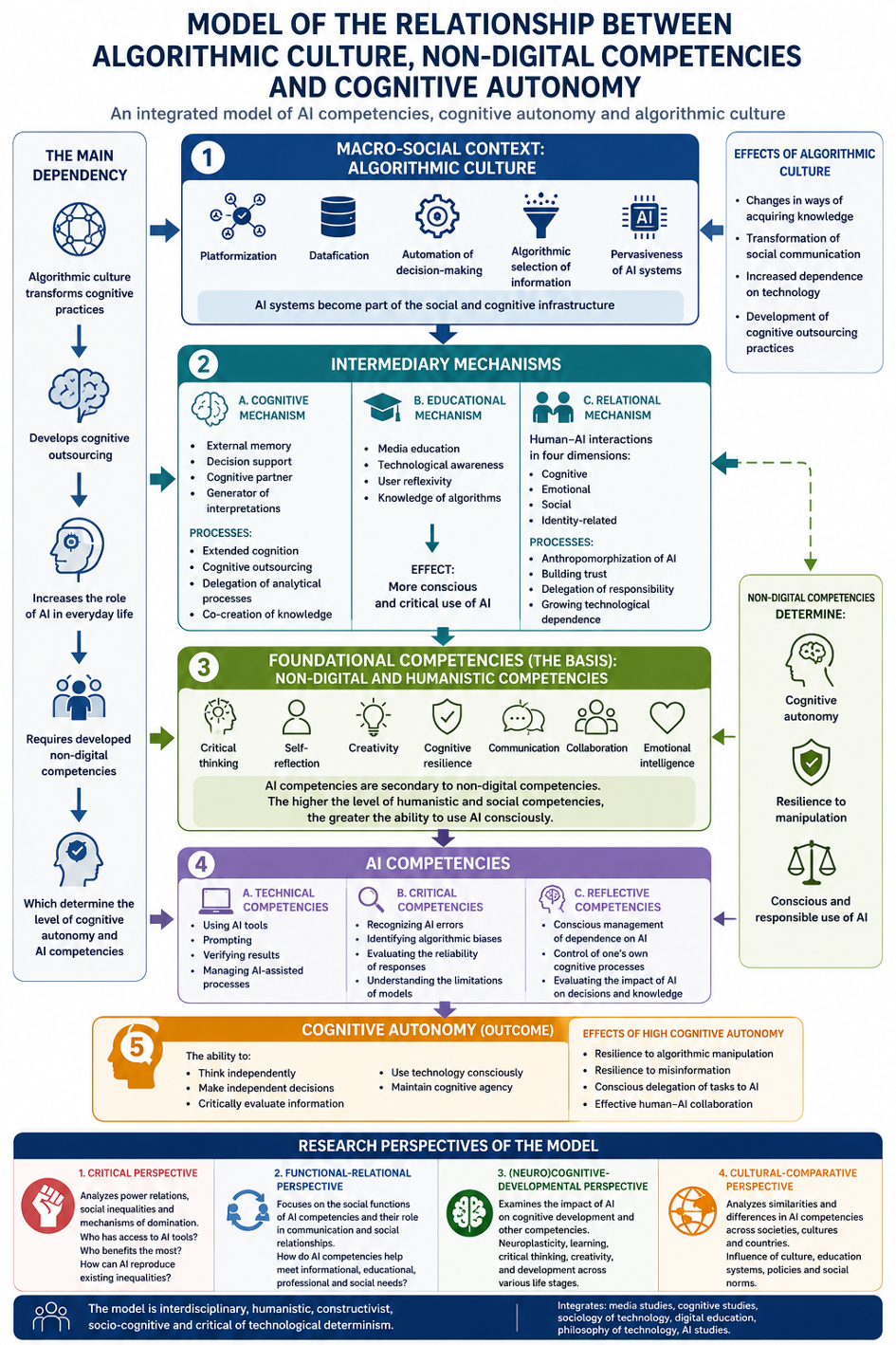
The Media Research Centre conducts interdisciplinary research on the social, cultural, educational, and cognitive consequences of the development of artificial intelligence in the context of algorithmic society. The Centre’s central research focus is the analysis of the relationship between the development of AI competencies and non-digital competencies, which constitute the foundation of autonomous and reflective functioning of individuals in contemporary media environments.
The starting point of the research is the assumption that generative artificial intelligence does not merely represent another stage in the development of digital technologies, but rather leads to a profound transformation of cognitive, communicative, educational, and cultural practices. In this view, AI is understood not only as a technological tool, but also as a cultural environment, a cognitive infrastructure, and an active mediator of social relations and everyday practices.
The research conducted at the Centre is grounded in the perspective of algorithmic culture, according to which algorithms and artificial intelligence systems co-organise processes of knowledge production, communication, information selection, content visibility, and both social and individual decision-making. The Centre analyses the impact of the platformisation of social life, the datafication of everyday practices, and the automation of cognitive activities on the ways in which reality is interpreted and how young adults function within digital environments.
A key area of research is the transformation of cognitive processes resulting from the increasingly frequent delegation of cognitive functions to AI systems. Within this perspective, phenomena such as extended cognition and cognitive offloading are examined, including AI’s assumption of functions related to memory, information analysis, content generation, knowledge organisation, creativity, and decision-making. Particular attention is given to the consequences of these processes for cognitive autonomy, critical thinking, learning practices, and users’ ability to reflectively evaluate information.
An important component of the Centre’s research is the development of critical media and digital education. AI competencies are understood as cultural, social, cognitive, and ethical competencies, rather than purely technical ones. In this view, the ability to use AI responsibly requires advanced critical competencies, including an understanding of the mechanisms underlying AI systems, ethical awareness, resistance to manipulation and disinformation, and the ability to interpret and verify information.
The Centre also conducts research on the relational dimension of human–AI interaction. Emotional, social, and identity-related aspects of AI use are analysed, including levels of trust in AI, processes of anthropomorphisation of technology, emotional attachment to AI systems, and the negotiation of responsibility between users and technology. Special attention is devoted to the growing role of AI as a cognitive partner, co-creator of content, mediator of communication, and source of emotional support.
A central thesis developed in the Centre’s research is the view that AI competencies are secondary to humanistic and social competencies. Effective and responsible use of AI systems depends primarily on levels of critical thinking, self-reflection, communication skills, creativity, cognitive resilience, and collaboration abilities. In this sense, the Centre develops a humanistic model of AI competencies, highlighting the fundamental importance of non-digital competencies for maintaining cognitive autonomy in algorithmic society.
The research is conducted using a longitudinal approach and a spiral model of AI competency development, according to which competencies evolve in a dynamic, multi-stage, and culturally embedded manner. This model enables the analysis of changes in AI usage practices over time, the stability of user attitudes, and adaptation processes to a rapidly changing technological environment.
The Centre conducts both quantitative and qualitative research. Quantitative analyses include panel models, longitudinal studies, regression models, factor analyses, and comparative studies across different cultural contexts. Qualitative research includes narrative analysis, discourse analysis, digital practice analysis, digital ethnography, and studies of everyday AI usage practices.
An important element of the Centre’s research programme is a cross-cultural perspective. Differences in AI usage practices and models of AI competency development across various social and cultural contexts, particularly within European countries, are examined.
At a theoretical level, the Centre develops an integrative approach combining research on algorithmic culture, media education, extended cognition theories, and studies of human–technology relations. The research aims to develop a new humanistic model of AI competencies, which will enable a better understanding of the social consequences of artificial intelligence development and the conditions necessary for maintaining individual cognitive autonomy in algorithmic society.
The Centre’s research contributes to international debates on the transformation of digital culture, the future of education, technology ethics, and the social consequences of artificial intelligence. Its aim is not only to diagnose changes in AI usage practices, but also to develop educational and competency models that support conscious, critical, and responsible human engagement in an algorithmic world.
Between Autonomy and Dependence: The Development of AI Competencies and Non-Digital Competencies among media users in Algorithmic Society
General Assumptions
The project is based on the assumption that generative artificial intelligence represents not merely a technological shift, but a profound transformation of cognitive, communicative, educational, and cultural practices.
AI is understood not only as a technological tool, but also as:
- a cultural environment,
- a cognitive infrastructure,
- a mediator of social relations,
- a non-human social actor co-shaping everyday practices.
The framework assumes that AI competencies are fundamentally:
- social,
- cultural,
- reflective,
- cognitive,
- ethical, rather than exclusively technical.
The central thesis of the project is that AI competencies are rooted in non-digital and humanistic competencies, which condition the individual’s ability to maintain cognitive and cultural autonomy in algorithmic society.
Algorithmic Culture as the Main Framework
The primary interpretative framework of the project is the concept of algorithmic culture, according to which algorithms and AI systems co-organize:
• knowledge production,
• communication processes,
• information selection,
• content visibility,
• cultural practices,
• everyday decision-making.
Within this perspective, AI becomes part of the social and cognitive infrastructure influencing how reality is interpreted and socially constructed.
The project assumes that young adults currently function within conditions of:
• platformization,
• datafication,
• automation of cognitive practices,
• increasing delegation of thinking and decision-making processes to AI systems.
Therefore, the development of AI competencies should be analyzed as a process of cultural adaptation to algorithmic society.
Cognitive Dimension: Extended Cognition and Cognitive Offloading
The framework incorporates theories of extended cognition and cognitive offloading.
AI systems increasingly assume functions related to:
• memory,
• information analysis,
• content generation,
• decision-making,
• knowledge organization,
• creativity,
• problem-solving.
As a consequence, the relationship between humans and cognitive processes is being transformed.
AI functions as:
• external cognitive support,
• a tool for mind extension,
• a co-participant in thinking and decision-making processes.
The project examines the consequences of these transformations for:
• cognitive autonomy,
• critical thinking,
• reflexivity,
• information verification,
• learning practices.
Educational Dimension: Critical Media Education
The project rejects a reductionist understanding of AI competencies as merely technical skills.
AI competencies are treated as cultural and reflective competencies requiring:
• critical analysis of technology,
• understanding of AI mechanisms,
• ethical awareness,
• interpretative abilities,
• resistance to manipulation and disinformation,
• reflection on the social consequences of technology.
The framework assumes that:
• media literacy,
• critical pedagogy,
• reflective media practices support more conscious and responsible uses of AI.
Relational Dimension: Human–AI Relations
The framework also includes the relational dimension of AI usage.
Interactions with AI systems are understood as:
• emotional,
• psychological,
• social,
• identity-related.
AI may function as:
• a cognitive partner,
• an advisor,
• a co-creator,
• a communication mediator,
• a source of emotional support.
The project therefore investigates:
• trust in AI,
• anthropomorphization of AI systems,
• emotional attachment,
• dependence on AI,
• negotiation of responsibility between humans and AI systems.
Research Methodology
Research Design
The project adopts a mixed-methods and longitudinal research design combining:
• quantitative analysis,
• qualitative analysis,
• comparative cross-cultural research,
• digital ethnography.
The study will be conducted in Poland, Spain, and Portugal.
Quantitative Research
Methods
• panel studies,
• longitudinal analysis,
• regression models,
• correlation analysis,
• factor analysis,
• structural equation modeling (SEM),
• comparative statistical analysis.
Variables
Independent Variables
• media literacy,
• non-digital competencies,
• AI usage intensity,
• educational practices,
• cultural context.
Mediating Variables
• reflexivity,
• trust in AI,
• cognitive autonomy,
• AI usage strategies.
Dependent Variables
• AI competencies,
• quality of AI practices,
• resistance to disinformation,
• ethical awareness,
• critical analysis skills.
Qualitative Research
Methods
• thematic analysis,
• discourse analysis,
• narrative interviews,
• digital ethnography,
• analysis of everyday AI practices.
Research Focus
• subjective experiences of AI use,
• transformations of learning practices,
• emotional relations with AI,
• negotiations of cognitive dependence,
• everyday strategies of interacting with AI systems.
Research Objectives and Research Questions
Main Objective
To analyze the relationships between non-digital competencies, AI competencies, and cognitive autonomy among young adults functioning in algorithmic society.
Research on AI competencies encompasses several key theoretical and analytical perspectives:
1. Critical Perspective
The critical perspective examines AI competencies through the lens of power relations, social inequalities, and mechanisms of domination present in the digital society. It draws on critical sociology as well as post-Marxist and neo-Marxist theories, which emphasize the impact of technology on social structures. This approach investigates, among other issues, who has access to artificial intelligence tools, which social groups benefit most from them, and how AI may reproduce existing economic, educational, and cultural inequalities. AI competencies are understood not only as technical skills but also as the ability to critically evaluate algorithmic processes, identify biases embedded in AI systems, and participate consciously in a data-driven society.
2. Functional-Relational Perspective
The functional-relational perspective focuses on the social functions of AI competencies and their role in communication processes and the formation of social relationships. It is rooted in functional sociology, particularly the work of Robert K. Merton. Within this framework, researchers analyze how AI-related competencies help individuals satisfy informational, professional, educational, and social needs. Particular attention is paid to human interaction with artificial intelligence systems and the impact of these technologies on communication in digital media environments. AI competencies are viewed as a resource that enables effective use of emerging technologies, facilitates collaboration and information exchange, and supports adaptation to changing social and media landscapes.
3. (Neuro)Cognitive-Developmental Perspective
The (neuro)cognitive-developmental perspective focuses on the impact of AI use on the development of cognitive processes and other individual competencies. Research within this perspective examines the relationships between AI competencies and the development of critical thinking, creativity, problem-solving abilities, and emotional and social competencies. A central role is played by the concept of neuroplasticity, which refers to the brain’s capacity to adapt in response to new experiences and technologies. Researchers investigate how interaction with AI tools influences learning processes, decision-making, cognitive development, and human functioning across different stages of life. AI competencies are therefore understood as part of a broader process of individual development within the digital environment.
4. Cultural-Comparative Perspective
The cultural-comparative perspective focuses on analyzing similarities and differences in AI competencies across societies, cultures, and countries. It assumes that the development and use of AI competencies are shaped by local cultural conditions, educational systems, levels of technological development, public policies, and social norms. Research conducted from this perspective seeks to identify patterns of AI use characteristic of different regions of the world, as well as factors that facilitate or hinder the development of these competencies. This approach contributes to a better understanding of both global and local dimensions of digital transformation and highlights how cultural contexts influence attitudes toward artificial intelligence and readiness to adopt and utilize AI technologies.
| Stage | Months |
| Theoretical model | 1-4 |
| Research tools | 5-7 |
| Pilot study | 8-10 |
| Main study | 11-15 |
| Modeling and analyses | 16-18 |
| Cross-cultural research | 19-21 |
| Implementation | 22-23 |
| Dissemination | 24 |